Rajasthan Exam 2025: Complete Guide for Government Job Aspirants | VJ Education
Introduction
The year 2025 is expected to bring a golden opportunity for lakhs of aspirants preparing for government jobs in Rajasthan. From teaching positions like REET to administrative roles through RPSC, and technical and clerical posts such as Patwari, Junior Assistant, and Rajasthan Police Constable—numerous exams are lined up under the Rajasthan Government’s recruitment calendar. VJ Education, a trusted name in exam preparation, is here to guide you every step of the way.
This comprehensive article provides detailed insights into Rajasthan Exam 2025: including eligibility, syllabus, exam pattern, preparation strategies, and how VJ Education’s test series, notes, and classes can give you a competitive edge.
Overview of Rajasthan Government Exams
Rajasthan conducts a variety of recruitment exams each year to fill vacancies in education, administration, police, finance, and other departments. These exams are conducted by different agencies like:
Rajasthan Public Service Commission (RPSC)
Board of Secondary Education, Rajasthan (BSER) – REET
Rajasthan Subordinate and Ministerial Services Selection Board (RSMSSB)
Rajasthan Police Recruitment Board
Department of Revenue, Rajasthan – Patwari Exam
Each exam has its unique eligibility criteria, exam pattern, and selection process. However, the one thing common across all is competition—and for that, systematic preparation is essential.
Exam-Wise Breakdown
Let’s dive into some of the most prominent exams under Rajasthan Exam 2025:
1. REET (Rajasthan Eligibility Examination for Teachers)
Levels:
Level 1: For Classes 1 to 5 (Primary Teachers)
Level 2: For Classes 6 to 8 (Upper Primary Teachers)
Eligibility:
Level 1: Senior Secondary + 2-Year D.El.Ed or B.El.Ed
Level 2: Graduation + B.Ed
Subjects:
Child Development & Pedagogy (CDP)
Language I (Hindi/Sanskrit/Urdu)
Language II (English)
Mathematics & Science / Social Studies
Environmental Studies (for Level 1)
VJ Education Offerings:
CDP and Pedagogy-focused classes
10+ Full-Length Model Papers
Daily Practice Sets
Hindi/English bilingual notes
2. RPSC (Rajasthan Public Service Commission)
Popular Posts:
RAS (Rajasthan Administrative Services)
Senior Teacher (Grade 2)
Assistant Professor
ACF, FRO, and more
Eligibility:
Bachelor’s degree for most exams
PG degree and NET for Assistant Professor
Exam Pattern (e.g., RAS):
Prelims: General Knowledge & Current Affairs
Mains: Four descriptive papers
Interview/Personality Test
VJ Education Support:
Subject-wise video lectures
Mock Interviews
GS and Current Affairs capsules
Essay writing workshops
3. Rajasthan Police Exam
Posts:
Constable
Sub-Inspector (SI)
ASI, and others
Eligibility:
Constable: 10+2
SI: Graduation
Stages:
Written Test
Physical Efficiency Test (PET)
Medical and Document Verification
VJ Education Resources:
Weekly physical training tips
Reasoning and GK test series
PYQ (Previous Year Questions) analysis
4. Patwari Exam
Eligibility:
Graduation + RSCIT Certificate
Subjects:
General Knowledge
Rajasthan GK
Mathematics
Reasoning
Computer Knowledge
VJ Education Advantage:
Rajasthan-specific GK notes
Daily MCQ practice
Doubt-clearing live sessions
5. Junior Assistant (Clerk Grade II)
Eligibility:
12th Pass + Computer Certification (RSCIT)
Exam Pattern:
Written Exam (GK + Everyday Science + Math + Hindi/English)
Typing Test
Support from VJ Education:
Typing practice software
Daily grammar sessions
Full-length practice tests
Syllabus & Eligibility: General Guidelines
Though each exam has its specific requirements, some common eligibility and subject patterns exist:
General Eligibility:
Indian citizen
Educational qualifications vary (from 10+2 to PG)
Age: 18–40 years (relaxations for reserved categories)
Common Subjects Across Exams:
General Knowledge (India + Rajasthan-specific)
Hindi/English Language
Mathematics/Reasoning
Current Affairs
Teaching Aptitude (for REET, RPSC Education Posts)
VJ Education provides concise, syllabus-mapped material across all these topics in Hindi and English both.
Preparation Tips for Rajasthan Exams 2025
Success in government exams depends on the right preparation strategy. Here's what you should focus on:
1. Understand the Syllabus Deeply
Study only what's relevant. Don’t waste time on outdated or off-topic content. Use VJ Education's updated syllabus guides.
2. Make a Realistic Study Plan
Divide time between subjects. Allocate more time to weak areas and revise regularly.
3. Practice Daily with Mock Tests
Mock tests not only help in time management but also build confidence. Use VJ Education's online test series for real-time simulation.
4. Focus on Rajasthan GK
This is often the game-changer in most exams. Use VJ Education's Rajasthan GK digest prepared by subject experts.
5. Work on Accuracy and Speed
Especially for objective papers, accuracy and time management are crucial. Solve previous year question papers regularly.
6. Improve Typing Skills (if applicable)
For exams like Junior Assistant, start practicing typing early. Use typing tools provided by VJ Education.
Why Choose VJ Education for Rajasthan Exam 2025?
VJ Education has helped thousands of students crack competitive exams in Rajasthan through its trusted, updated, and effective learning system. Here's how:
Expert Faculty
Experienced educators who understand exam trends and how to simplify tough topics.
Updated Test Series
Thousands of questions covering all topics, with real-exam level difficulty.
Bilingual Content
Study material available in both Hindi and English mediums for better understanding.
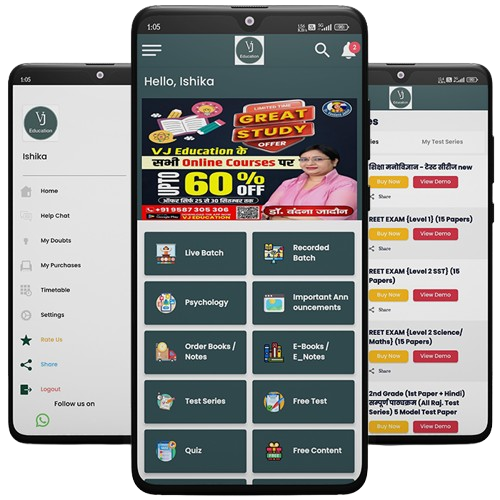
Mobile App + Online Portal
Access notes, tests, video classes, and PDFs anytime, anywhere.
Doubt Clearing & Mentorship
Live doubt sessions, one-on-one mentoring, and motivational support till your selection. | VJ Education
.png)


.png&w=1920&q=75)
-1-1.png&w=1920&q=75)
-1.png&w=1920&q=75)

.png)
-1-1.png)
-1.png)

 Bihar Exams Preparation
.png) Rajasthan exams 2025
Rajasthan exams 2025 IPSC Exam
 UPTET Exam
 Super TET_ Exams
 CRPF
CRPF SSC
SSC RRB
RRB